
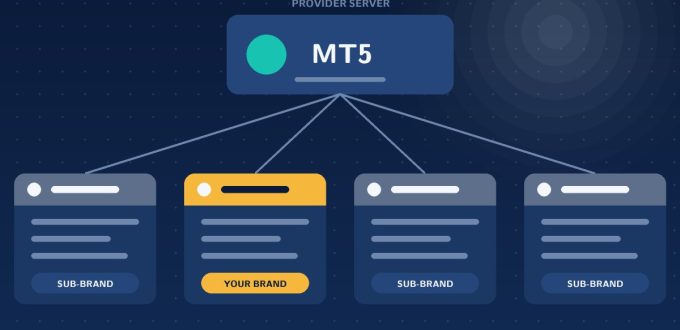
A forex grey label is the fastest and cheapest way to put your own brand in front of traders on a professional trading platform. Instead of building infrastructure, leasing a full licence and incorporating a company before you can accept a single client, you run your brokerage on a setup a provider already operates. The trade-off is less control and a smaller share of the economics. This guide explains how a grey label actually works, what you get, what to watch out for, and when it makes sense to move up to a white label.
What a forex grey label is
In a grey label arrangement, the provider holds the platform licence and runs the server. You operate a sub-brand on top of it: your own logo and domain, your own client accounts, and your own pricing within the limits the provider allows. Clients trade on a standard MetaTrader terminal and, from their side, the experience looks like any other broker.
The term is used loosely across the industry. Some providers sell a heavily restricted “grey label” that is little more than an IB link, while others offer a properly configurable group on a live server. Because there is no universal definition, always check exactly what the contract gives you rather than relying on the label.
How a grey label works in practice
- The provider runs the trading server. They maintain the MetaTrader infrastructure, the data feed and the server-side configuration.
- You get your own group or groups. A group is a set of accounts with its own conditions: markup, spread, commission, leverage and the instruments you offer.
- You set your own pricing. Within the group, you decide the markup and commission that become your revenue per trade.
- You bring the clients. Marketing, onboarding and support are yours. The provider does not compete for your traders.
- Your back office connects to the platform. A CRM and traders cabinet linked through the manager API turn account creation, deposits and withdrawals from manual work into automated flows.
What you typically get
Exact inclusions vary by provider, but a solid grey label package normally covers:
- A defined number of account groups on a live MetaTrader server
- Control over markup, spread and commission on those groups
- A market data feed, either bundled or charged separately
- Access to forex, CFDs, metals and often crypto instruments
- The ability to run a B-book model, meaning you act as the counterparty to client trades
Our own MetaTrader grey label offer, for example, includes an MT5 manager with up to 4 groups, your own markup, spreads and commission, a free data feed, unlimited B-book, no incorporation or documents required to start, and a go-live time of under 24 hours.
Advantages of a forex grey label
- Speed. Hours or days to go live rather than the weeks or months a white label or full licence can take.
- Low entry cost. There is no platform licence fee or server to buy, so you can validate demand before committing serious capital.
- More control than an IB deal. You decide your own markups and conditions instead of accepting a fixed rebate.
- Focus on acquisition. The technical heavy lifting is handled, so your time goes into marketing and retention.
Risks and limits to understand
- Group limits. A cap on the number of groups can restrict how many account types you offer, for example standard, VIP and a zero-spread tier.
- Dependency on the provider. Your uptime, execution and compliance posture depend on the provider you sit under. Their problems become your problems.
- Thinner margins at scale. Ongoing fees, revenue share or per-lot charges can erode the early cost advantage as volume grows.
- Limited back-end access. You normally cannot touch server-level settings the way a white label or full licence holder can.
- Migration friction. Moving clients to your own white label later is easier with some providers than others, so settle the exit terms before you start.
Who a forex grey label suits
A grey label is a strong fit if you want to test a market quickly, you already have an audience or IB network that you can convert into direct clients, or you are a regional operator who wants a branded offering without a large upfront build. It is a weaker fit if you need many symbol groups, custom server-level rules, or you already process meaningful monthly volume. At that point the economics of a forex white label usually start to win. We compare the two head to head in grey label vs white label forex.
What to put in writing before you start
- How many groups you get, and what a new group costs
- Who holds client funds and how withdrawals are processed
- Whether the data feed is included and how pricing is sourced
- All fees: setup, monthly, per-lot, revenue share, and any minimums
- Who owns the client data and what happens if you leave
- Your options for upgrading to a white label
If a provider will not answer these clearly, that tells you what you need to know. For the wider picture of getting a brokerage off the ground, our 12-step broker setup checklist shows where the grey label fits into the full launch.
Frequently asked questions
What is a forex grey label?
A forex grey label is an arrangement where you run your own brand, with your own clients and pricing, on trading infrastructure and a licence that a provider already holds. You do not run the server or incorporate your own regulated entity just to begin trading.
Is a grey label the same as an IB?
No. An introducing broker (IB) typically refers clients to a broker and earns a share of the spread or commission, with no control over trading conditions. A grey label operator sets its own markup, spreads and commission on its own group of accounts and usually has its own branded client experience.
Do I need a forex licence for a grey label?
Often you can begin operating without incorporating your own company, because the provider’s setup carries the platform side. Regulatory requirements depend on where you market and who your clients are, so check the rules in your target countries before you take deposits.
Can I move from a grey label to a white label later?
Yes, and many brokers do exactly that once they have real volume. Ask your provider about migration terms up front, including whether client accounts and history can move with you.
Want to see what a grey label setup looks like with live conditions? Review our MetaTrader grey label or contact us and we will walk you through it.