
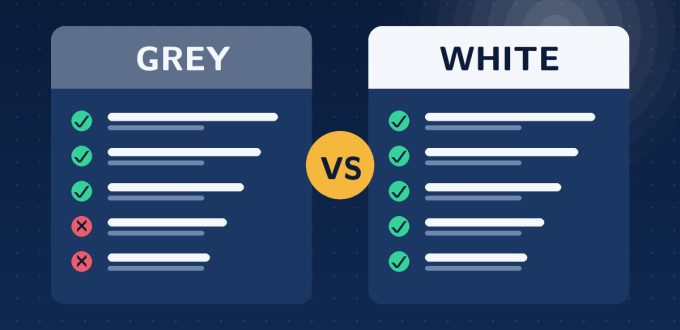
Choosing between a grey label vs white label forex setup is the first real decision most new brokers face, and the two terms are often used interchangeably by providers who benefit from the confusion. They are not the same. They differ in speed, cost, control, branding depth and how easily you can grow. This comparison lays out the differences plainly so you can match the model to your stage of business.
The short version
A forex grey label is fast, cheap and limited. A forex white label is slower, costlier and far more flexible. Neither is better in the abstract; each is better at a particular stage.
Side-by-side comparison
| Factor | Grey label | White label |
|---|---|---|
| Time to launch | Hours to days | Typically several weeks |
| Upfront cost | Low, sometimes waived | Moderate to high |
| Account groups | Small fixed number | Many, more granular |
| Pricing control | Markup, spread, commission within groups | Broader trading-condition control |
| Branding | Your brand on the client layer | Full branding, often with website and cabinet |
| Incorporation needed | Often not to start | Depends on jurisdiction and target clients |
| Server-level access | Minimal | Deeper, varies by provider |
| Best for | Testing a market, small operators | Established flow, multi-product brokers |
Cost: where the money really goes
The headline difference is upfront cost, but the gap closes or reverses over time. A grey label keeps entry costs minimal, which is its whole point. A white label shifts spending toward setup, monthly platform fees and the supporting stack of CRM, traders cabinet and liquidity.
For reference, our own Forex Broker in a BOX white label package is rented from €499 to €699 per month or leased as a one-off €4,500 to €6,500, on top of a MetaQuotes setup fee of about $5,000 for a full licence. Our grey label, by contrast, currently has its setup fee waived. Industry estimates for white label setup elsewhere vary widely, so treat any single figure with caution and ask for an itemised quote. We break the numbers down further in our cost to start a forex brokerage guide.
Control: the constraint that eventually bites
Most operators who outgrow a grey label do so because of control, not price. Typical pressure points are:
- Needing more account types than the group limit allows
- Wanting finer control over symbols, leverage and execution rules
- Needing your own website and client portal to look and behave exactly as you design them
- Wanting a deeper integration between platform, CRM and payments
If you can already see these needs on day one, start with a white label. If you are still proving the concept, a grey label lets you learn cheaply.
Branding and client experience
Both models let you present your own brand, but the depth differs. A grey label usually brands the client-facing layer on a shared backbone. A white label commonly bundles a full branded website, traders cabinet and CRM, so the whole journey from landing page to withdrawal is yours.
Risk and dependency
On a grey label you rely heavily on the provider’s infrastructure and standing. On a white label you rely on them too, but with more configuration freedom and typically a clearer separation. In both cases the provider’s reliability is your reliability, so due diligence on uptime, support and financial standing matters more than the label on the contract.
A simple way to decide
- Do you already have clients or an IB network ready to onboard? If yes and you want speed, grey label.
- Do you need more than four or five account types? If yes, white label.
- Is your budget tight and your market unproven? Grey label first.
- Do you need a fully custom client journey? White label.
- Will you process meaningful volume in the first year? Model the fees at that volume. White label often wins.
Many brokers do both in sequence: launch on a grey label, then migrate to a white label once the numbers justify it. Agree the migration terms before you begin. Our white label vs broker-in-a-box vs in-house comparison covers the next step up.
Frequently asked questions
What is the main difference between grey label and white label forex?
A grey label gives you a defined slice of someone else’s server and licence, so you can launch quickly with limited configuration. A white label gives you a more complete, deeper-configured platform under your own brand, usually with more control, more groups and a longer setup.
Which is cheaper, grey label or white label?
Grey label is cheaper to start. White label costs more upfront and monthly, but can work out better per client at higher volumes because you have more control and fewer constraints.
How long does each take to launch?
A grey label can go live in hours or days. A white label commonly takes several weeks, depending on branding, integrations and configuration.
Can I start with a grey label and upgrade?
Yes. It is a common route: validate demand on a grey label, then move to a white label once volume justifies it. Agree migration terms before you start.
Not sure which model fits? Talk to us or compare the MetaTrader grey label and the Forex Broker in a BOX.