
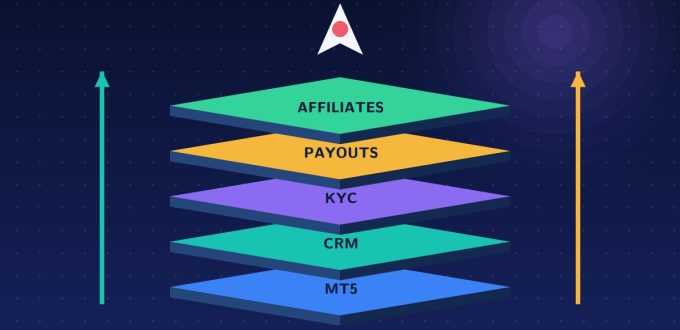
If you want to launch a prop firm, the business model is simple: sell evaluations, fund the traders who pass, and share the profits. The technology that makes that model run at scale is not simple. A prop firm is, operationally, a high-volume onboarding, monitoring and payments machine. This guide maps the full tech stack, explains how the pieces connect and shows where new firms most often go wrong.
The prop firm tech stack at a glance
- Trading platform where challenge and funded accounts trade
- Prop firm CRM that runs the challenge lifecycle
- Trader dashboard where traders see their progress and request payouts
- KYC and agreements for onboarding and compliance
- Payments and payouts for fees in and profit splits out
- Affiliate and partner system that drives challenge sales
- Risk and reporting to keep the whole operation visible
1. The trading platform
Most prop firms run MetaTrader 5, MetaTrader 4 or cTrader. For MetaTrader, you can access a server several ways. A MetaTrader grey label is the quickest and cheapest route, useful for validating demand. An MT5 white label gives more groups and control, which matters once you offer several account sizes and plan types. Whichever you pick, the CRM connects through the MT5 Manager API to create accounts and read live balance and equity. If you are weighing the models, see grey label vs white label forex.
2. The prop firm CRM
This is the brain of the operation. It must manage challenge plans, phases, rules and breaches, promote traders through stages and keep a single history per trader across many accounts. We cover the required capabilities in detail in prop fund CRM: how challenge phases, breaches and funded accounts work.
3. The trader dashboard
Traders constantly ask the same questions: how close am I to the drawdown limit, which phase am I in, when is my payout? A clear dashboard answers them without support staff. A well-designed traders cabinet doubles as this dashboard, with objectives, progress and payout status in one place.
4. KYC and agreements
Challenge attempts are cheap and repeatable, so account volume can far exceed a typical retail broker’s. Manual document review does not scale. You want automated document collection, one-click approval and a stored record of signed agreements, ideally triggered at the right gate, such as before the first payout.
5. Payments and payouts
Money flows in as challenge fees and out as profit splits. The inbound side is a payment integration problem. The outbound side is a rules problem: calculating the split, checking payout conditions, approving and releasing funds with a full audit trail. Our guide to prop firm payout automation shows what the automated version looks like.
6. Affiliates and partners
Most prop firms rely on affiliates, creators and communities for challenge sales. You need accurate attribution, flexible commission tiers and reliable payout reporting, or partners lose trust fast. This runs on the same infrastructure as IB and affiliate management in a forex CRM.
7. Risk and reporting
You need visibility on pass rates, breach reasons, open exposure and payout liabilities. Even if your firm simulates trading, funded accounts carry real financial commitments, so treat monitoring as core infrastructure, not an extra.
How the pieces connect
A trader buys a challenge. The payment confirms; the CRM creates the account on the platform through the API. The rules engine watches live data. The trader passes; the CRM promotes them, triggers KYC and creates a funded account. Profits accrue; the payout workflow calculates and releases the split. An affiliate who referred the trader is credited automatically. Every arrow in that chain is an integration, and every manual step you leave in is a place where volume will break you.
Common launch mistakes
- Starting with a generic CRM. It lacks challenge logic, so you end up with spreadsheets and scripts.
- Under-provisioning groups. Plan account sizes, phases and plans first, then count the groups they need.
- Manual payouts. They feel manageable at ten traders and become a full-time job at a few hundred.
- Selling before testing the full journey. Run a complete cycle yourself: purchase, breach, pass, funded, payout.
- Ignoring legal structure. How your offer is classified varies by jurisdiction. Get advice early, as our license comparison illustrates for brokerages.
A sensible launch sequence
- Design your plans: sizes, phases, rules, fees, split.
- Choose the platform route (grey label to validate, white label to scale).
- Configure the CRM with your rules and connect it to the platform.
- Set up KYC, agreements and payments.
- Configure payouts and test the whole cycle.
- Launch affiliates and start selling.
For the wider infrastructure context, see what a prop trading firm needs from its back office.
Frequently asked questions
What technology do I need to launch a prop firm?
A trading platform (commonly MT5, MT4 or cTrader), a prop firm CRM with a challenge and rules engine, a traders dashboard, KYC and agreement handling, payment and payout processing, and an affiliate system.
Do I need a forex broker licence to start a prop firm?
Not necessarily, because many prop firms sell evaluation services rather than accept client deposits to trade. Regulation depends on how your offer is structured and where you sell, so take legal advice for your jurisdictions.
Can I launch a prop firm on a grey label MT5 setup?
It can work for early validation, particularly if you need only a few account configurations. As challenge sizes, plans and volumes multiply, many firms move to a white label with more groups and control.
How long does it take to set up prop firm technology?
A lean setup on existing infrastructure can be quick, but a full stack with custom rules, KYC, payouts and affiliates takes longer. Budget weeks rather than days and test the full trader journey end to end before selling.
Planning a funded-trader business? See our Forex CRM and MetaTrader grey label, or contact us to scope your stack.