
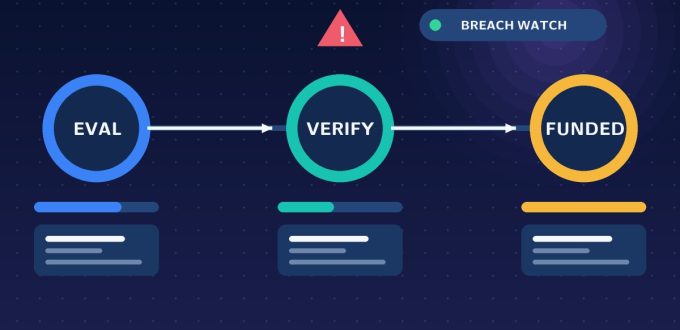
A prop fund CRM is not a sales tool with a trading skin on top. It is the operational system that decides whether a funded-trader business runs smoothly or drowns in manual work, disputes and support tickets. The customer relationship in a prop firm is a lifecycle, not a funnel: a trader buys a challenge, trades under rules, gets verified, receives a funded account and is paid on a schedule. Every step is a state your software has to track and automate. This guide walks through what that looks like and what to demand from prop firm CRM software.
Prop fund vs prop firm: the terminology
You will see both terms. “Prop firm” is by far the dominant phrase in search and in the industry, but “prop fund” is widely used as shorthand for the same model: a company that supplies trading capital to traders who prove themselves in an evaluation, then shares the profit. Whichever you use, the software requirements are identical, and our broader overview is in what proprietary trading firms need from their back office.
The challenge lifecycle, stage by stage
1. Challenge purchase
A trader pays an evaluation fee, which is not a deposit. The CRM must record the purchase, apply the right plan and account size, and trigger account creation on the trading platform automatically. Manual account creation breaks down fast when popular challenges generate hundreds of sign-ups.
2. Evaluation phase
The account trades against a rule set: profit target, daily loss limit, maximum drawdown, minimum trading days and sometimes consistency or lot-size rules. The CRM needs to show each trader’s progress against every rule in real time.
3. Verification phase
Many programs add a second, often easier, phase. The system should move the trader forward without losing history, creating the next account and applying the next rule set automatically.
4. Funded account
On passing, the trader receives a funded account, usually with different capital, rules and a profit split. KYC and agreement signing typically gate this step, which is where automated document handling saves large amounts of staff time.
5. Payouts
The firm calculates the trader’s share on a schedule, checks the account against payout conditions and releases funds. This is covered in depth in our guide to prop firm payout automation.
Breach monitoring: the feature that matters most
Rules only mean something if they are enforced consistently and instantly. A daily drawdown breach discovered at the end of the day, or worse by a support agent the next week, creates disputes and undermines trust in your program. Effective breach monitoring depends on:
- A live connection to the trading server through the manager API for balance, equity and open positions
- Rules defined once and applied automatically to every account of that plan
- Instant actions: flag, disable trading, close positions or fail the phase, depending on your policy
- A clear audit trail showing exactly what triggered the breach and when
The quality of the MetaTrader API integration underneath is what separates software that enforces rules from software that merely records them.
The prop fund CRM feature checklist
- Challenge and plan builder. Define account sizes, phases, rules and fees without a developer.
- Multi-account trader profiles. One trader, several accounts across phases, one history.
- Automated account creation and promotion. No manual steps between purchase, phase change and funding.
- Rule and breach engine. Real-time, rule-by-rule, with configurable consequences.
- KYC and agreements at scale. One-click approval, document storage and a clear compliance record.
- Payout workflow. Profit-split calculation, approval queues, scheduling and auditable transfers.
- Affiliate and IB tracking. Prop firms depend on affiliates for challenge sales, so commissions per challenge sold must be tracked and reported. See how multi-tier tracking works in our guide to IB and affiliate management.
- Trader dashboard. A client-facing view of objectives, progress and payout status, so support is not answering the same questions repeatedly. A well-built traders cabinet provides this.
- Reporting. Pass rates, breach reasons, payout totals and affiliate performance in one place.
Where a standard forex CRM fits and where it does not
The underlying infrastructure is shared: MetaTrader account management, KYC, transaction management and affiliate tracking are core features of any good forex CRM. The difference is configuration and triggers. Accounts are created on challenge purchase rather than sign-up. Transfers are tied to payout schedules rather than client-initiated withdrawals. So the right question to put to any vendor is not “do you have a prop product?” but “how flexibly can your core CRM and API integration be configured to run challenge logic?” Our guide to the complete forex CRM feature set shows the foundation you are building on.
Red flags when evaluating prop firm CRM software
- Rules monitored on a delay or by manual export
- No support for multiple accounts per trader across phases
- Payout calculations done in spreadsheets outside the system
- No affiliate module, or one that cannot attribute challenge sales
- A generic sales CRM rebranded for prop trading
Ask for a live demonstration of a full cycle: a challenge purchase, a phase change, a breach and a payout. Software that handles all four end to end is ready for real volume.
Frequently asked questions
What is a prop fund CRM?
A prop fund CRM, more commonly called a prop firm CRM, is back-office software built around the challenge lifecycle: selling evaluations, tracking each trader through phases, monitoring rule breaches, promoting funded accounts and paying out profit splits.
Is a prop fund the same as a prop firm?
In practice the terms are used interchangeably. Both describe a company that funds traders who pass an evaluation and shares the profits. Software vendors and traders mostly search for and say prop firm, but prop fund is common shorthand.
Can a normal forex CRM run a prop firm?
Partly. The core plumbing is the same: MetaTrader account management, KYC, transactions and affiliate tracking. What a standard forex CRM lacks is the challenge engine, automated breach rules and payout scheduling, so check how configurable it is before assuming it will fit.
Which trading platforms do prop firm CRMs integrate with?
Most firms run MetaTrader 4, MetaTrader 5 or cTrader. The key requirement is a live manager or server connection that provides real-time balance, equity and position data, because breach monitoring depends on it.
Building a funded-trader business? See what our forex CRM can be configured to do or contact us to discuss your challenge setup.