B-Book vs A-Book for Forex Brokers: Risk, Revenue and Hedging Explained
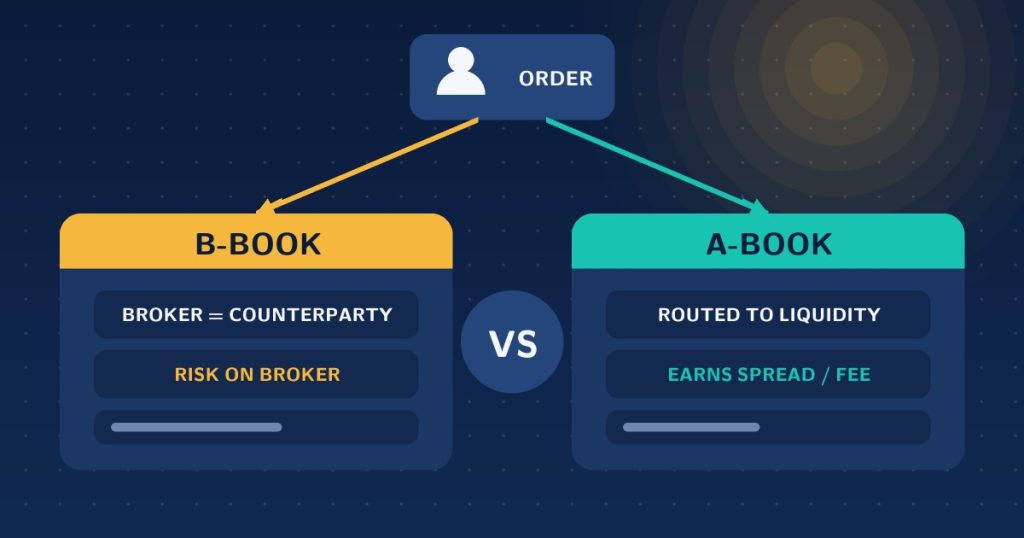
Quick answer: In a B-book model the broker keeps client trades on its own book and is the counterparty, so it profits when clients lose and carries the market risk. In an A-book model the broker passes trades to a liquidity provider and earns spread, markup or commission with little market risk. Most brokers run a hybrid of both.
Every forex brokerage has to answer one question early: what happens to a client’s order after they click buy or sell? The answer defines how you make money, how much risk you carry and what technology you need. The two classic answers are B-book vs A-book, and most mature brokers end up with a blend. This guide explains each model, the real trade-offs and how to choose.
What is a B-book?
In a B-book model the broker does not send the client’s trade to the market. It keeps the position on its own book and becomes the counterparty. If the client loses, the broker keeps the loss as revenue. If the client wins, the broker pays the profit out of its own capital. Revenue therefore depends on aggregate client results, not just on trading volume, and the broker carries market exposure on the net open positions.
What is an A-book?
In an A-book model the broker passes client orders to a liquidity provider or the interbank market, either directly or through a bridge. The broker earns from the spread, markup and commission it adds, regardless of whether the client wins or loses. Market risk sits with the liquidity provider and the client, not the broker. Revenue grows with volume and is far steadier.
Side-by-side comparison
| Factor | B-book | A-book |
|---|---|---|
| Counterparty | The broker | Liquidity provider or market |
| Revenue source | Net client results plus spread and commission | Spread, markup, commission |
| Market risk | On the broker | Mostly off the broker |
| Revenue stability | Volatile | Steadier |
| Capital needed | Higher, to absorb winners | Lower for risk, but liquidity costs apply |
| Extra infrastructure | Risk monitoring and exposure controls | Liquidity connection and bridge |
| Conflict of interest | Higher; scrutinised by regulators | Lower |
The hybrid model: what most brokers actually run
Few brokers stay purely on one side. A hybrid (sometimes called a C-book) model internalises part of the flow and hedges the rest. Typical approaches include:
- Segmenting by client. Keep small, lower-risk retail flow in-house and route consistently profitable or large accounts to a liquidity provider.
- Segmenting by size or instrument. Hedge any position above a defined threshold or in more volatile instruments.
- Net exposure hedging. Allow client positions to offset each other, then hedge only the remaining net exposure.
The rules you choose should be written down, tested and applied consistently, not improvised trade by trade.
What each model requires from your technology
For a B-book
You need real-time visibility of net exposure, client profitability and drawdown, plus the ability to move an account or a group between books quickly. MetaTrader groups are the natural unit for this, which is one reason group limits matter on a forex grey label.
For an A-book
You need a liquidity relationship, a bridge or gateway between the platform and the provider, and pricing that reflects your costs. Our guide to the MetaTrader API explains how the platform side connects.
For either
You need a CRM that reflects account groups, balances and transactions accurately, so risk, finance and compliance are working from the same numbers.
Regulatory and ethical considerations
Internalising client flow creates a conflict of interest, and regulators in many jurisdictions require clear disclosure, fair pricing and best-execution policies. Some regimes restrict or monitor B-book practices more closely than others. Because rules differ by country and change over time, take local legal advice for each market you serve and document your execution policy. Our offshore license comparison shows how much the regulatory environment varies.
How to choose
- How much capital can you put behind client winners? Thin capital argues for A-book or heavy hedging.
- How good is your risk monitoring? A B-book without live exposure data is a gamble.
- What are your clients like? Trader profile determines how much flow is safe to internalise.
- What does your licence or provider allow? Some arrangements limit internalisation.
- Do you want predictable or variable revenue? Investors and operating budgets often prefer predictable.
Many new brokers start with a B-book on a grey label to keep costs down, then add an A-book connection as volume and exposure grow. Whichever you pick, decide it as part of setup rather than after you have onboarded clients, as we stress in our 12-step broker setup checklist.
Frequently asked questions
What is the difference between A-book and B-book?
In an A-book model the broker routes client orders to a liquidity provider or the interbank market and earns a markup or commission. In a B-book model the broker keeps the orders in-house, acts as the counterparty and carries the market risk.
Which is more profitable, A-book or B-book?
B-book can earn more per client when clients trade at a net loss, but it carries market risk and variance. A-book revenue is steadier and more predictable because it comes from spread, markup and commission rather than client losses.
What is a hybrid or C-book model?
A hybrid model internalises some flow and hedges the rest, usually by sending profitable or large positions to a liquidity provider while keeping smaller or lower-risk flow in-house. The rules for splitting flow vary by broker.
Can I run a B-book on a grey label or white label?
Often yes, subject to your provider’s terms and your regulatory position. Our MetaTrader grey label includes unlimited B-book, but confirm internalisation rights and disclosure obligations for your jurisdiction before relying on it.
Need a platform that supports both books? See our MetaTrader grey label or contact us to plan your setup.