Forex Liquidity Provider: How New Brokers Choose an LP and Bridge
Quick answer: A forex liquidity provider (LP) supplies the prices your clients trade on and takes the other side of the trades you pass on (A-book). New brokers usually start with a prime of prime LP, connected to MT5 through a bridge, because tier-1 banks require large balances and volume. Compare LPs on real spreads and execution, margin requirements, instrument range, fees and support, not on headline marketing.
You can run a brokerage for a while without thinking hard about liquidity, especially on a grey label where the provider handles feeds and you mostly B-book. But as soon as you want to A-book larger traders, offer raw-spread accounts or hedge your exposure, the choice of liquidity provider becomes one of the most important decisions you make.
What a liquidity provider actually does
- Streams prices (bid and ask) for the instruments you offer
- Executes orders you send it, so the risk leaves your book
- Holds your margin and extends you credit to trade
- Reports fills, positions and costs so you can reconcile
Your clients never deal with the LP directly. They trade on your MT5 server; your risk settings decide which trades stay in-house and which go out. See B-book vs A-book for how that split works.
Types of liquidity providers
| Type | Who it suits | Typical entry barrier |
|---|---|---|
| Tier-1 banks | Large, regulated brokers with prime brokerage | Very high balances and volume |
| Prime of prime (PoP) | Small and mid-size brokers | Moderate margin deposit |
| Non-bank market makers | Brokers wanting tight streaming prices | Varies by relationship |
| Aggregated pools via bridge | Brokers mixing several LPs | Bridge cost plus each LP’s terms |
Almost every new broker starts with a PoP. It gives you access to aggregated bank and non-bank liquidity without the balance sheet a bank relationship needs.
The bridge: how MT5 connects to an LP
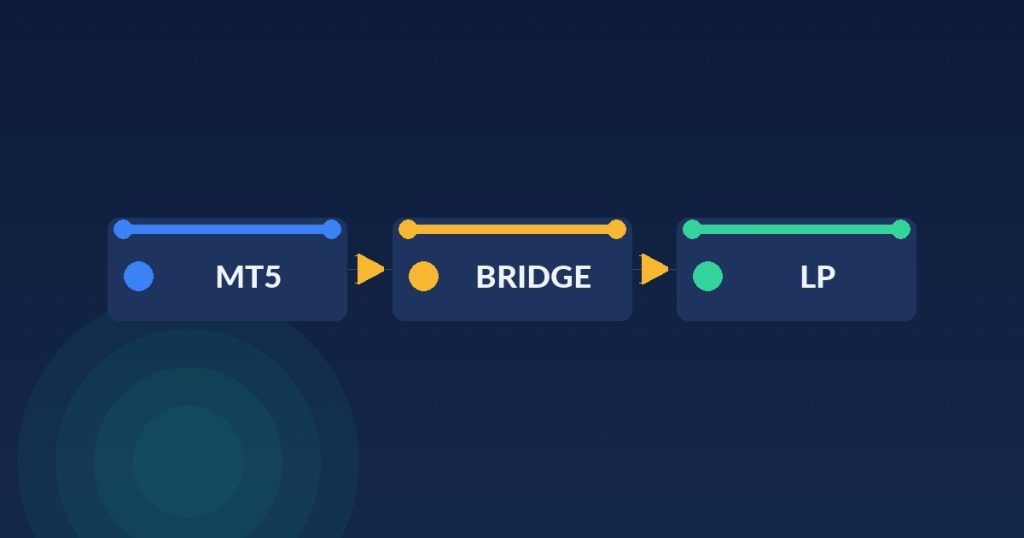
MT5 does not speak to every LP natively. A bridge (or gateway) sits between your server and one or more LPs, usually over FIX. It handles:
- Routing rules: which groups, symbols or trade sizes go to which LP
- Markup on the price stream
- Partial fills, rejects and requotes
- Failover if one LP goes down
Some LPs offer their own MT5 gateway, which saves the bridge fee but ties you to them. A third-party bridge costs more but lets you add or switch LPs without touching client accounts.
What to compare between LPs
- Real spreads at real times. Ask for tick data during London open, US data releases and Asian session, not a brochure average.
- Execution quality. Fill rates, slippage symmetry and rejection rate.
- Commission and fees. Per million traded, minimum monthly fees, connection fees.
- Margin and leverage they give you, and how quickly they change it in volatile markets.
- Instrument range: forex, metals, indices, energies, crypto CFDs, stocks.
- Regulation and counterparty risk. Where is your margin held, and who regulates them?
- Onboarding requirements: what corporate documents and licence they need from you.
- Support at 3am when a feed freezes.
Liquidity mistakes new brokers make
- Choosing on spread alone. Tight quotes with bad fills cost more than wider quotes with clean execution.
- A-booking everything too early. You pay LP costs on small, unprofitable flow.
- No failover. One LP, one connection, one bad day.
- Not reconciling. Your MT5 positions, bridge logs and LP statements should match every day.
Where PremiumSystems fits
We are a technology provider, not a liquidity provider. Our MetaTrader grey label includes a free data feed and unlimited B-book so you can start without an LP. When you are ready to A-book, our Full Forex Broker Package runs MT5 alongside the LP and bridge you choose, and the CRM shows which groups route where. Our forex CRM integrations guide explains how it fits together.
Frequently asked questions
What is a forex liquidity provider?
A bank or financial firm that streams prices to a broker and executes the trades the broker passes on, so the broker can offset client risk.
Do I need a liquidity provider to start a forex brokerage?
Not always on day one. On a grey label you can use the provider’s data feed and B-book client trades. You need an LP when you want to A-book or hedge exposure.
What is prime of prime liquidity?
A firm that has prime brokerage relationships with large banks and resells aggregated access to smaller brokers who could not meet bank requirements directly.
What is a liquidity bridge?
Software that connects your MT5 server to one or more liquidity providers, routes orders by your rules, applies markup and handles failover.
How much deposit does a liquidity provider require?
It varies widely. Prime of prime providers are far more accessible than tier-1 banks. Ask each LP for its minimum margin, monthly minimums and connection fees.
Planning your execution model? Talk to us about running MT5 with your chosen LP.